
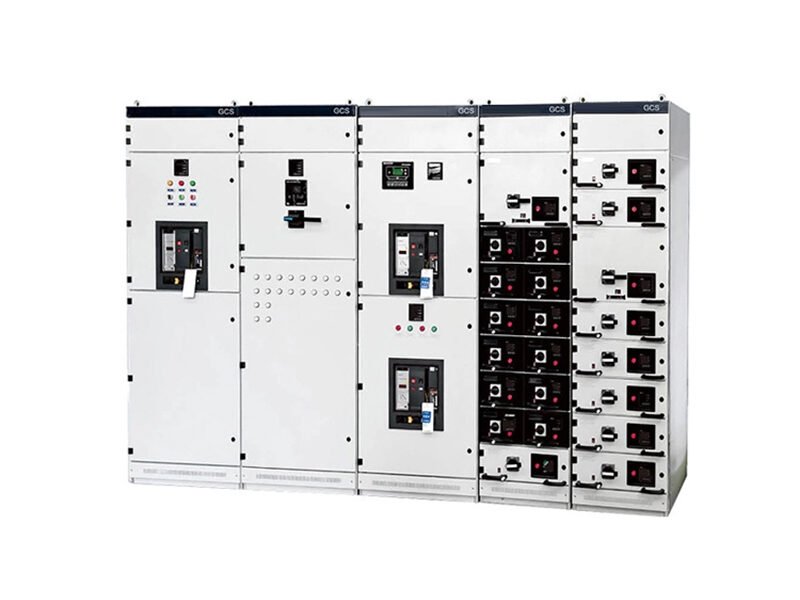
GCS vs GCK vs MNS: Which Withdrawable LV Switchgear Fits Your Project
Three model codes dominate Chinese low voltage switchgear catalogues: GCS, GCK and MNS. All three are withdrawable, all three are built to IEC 61439, and all three are quoted for the same tender packages. The differences are not cosmetic — they decide how many circuits fit in a row, how fast a faulted feeder can be swapped, and how much of the panel you can actually work on while the busbar stays live.
This comparison is written from the buyer’s side of the table: what to check in a quotation, and which platform suits which project.

1. Why withdrawable in the first place
A fixed panel (GGD being the classic example) bolts the breaker to the busbar. A withdrawable panel puts the breaker in a cassette that slides out, so a failed feeder can be replaced in minutes instead of a shutdown. That convenience has a price: more sheet metal, more interlocks, more machining tolerance, and a higher unit cost.
Whether it is worth paying for depends on one question: how often will someone need to change or test a feeder while the plant is running? Continuous process plants, data centres, hospitals and steel mills answer “often”. A small workshop distribution board answers “almost never” — and a fixed GGD panel will do the job for a fraction of the money.
2. The three platforms side by side
| Item | GCS | GCK | MNS |
|---|---|---|---|
| Rated voltage | 400 V / 690 V | up to 690 V | up to 690 V |
| Max rated current | 4000 A | 3150 A | 4000 A |
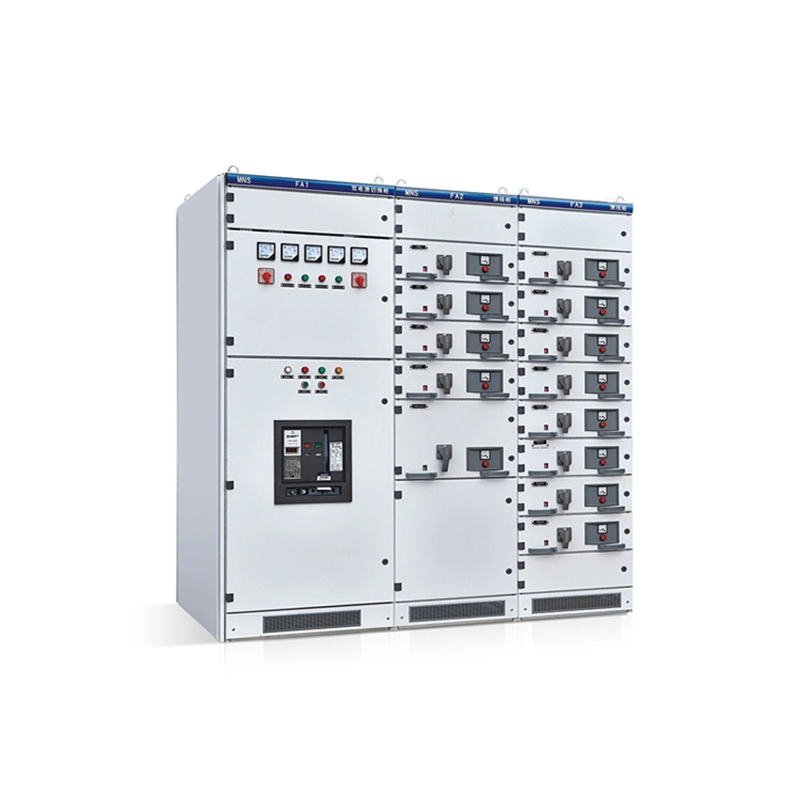
| Structure | PC + MCC in one row, drawer units | PC cabinet and MCC cabinet, drawer units | Modular, mixed feed and motor units in one column |
| Standard quoted | IEC 61439-1/-2 (older sheets say IEC 60439-1) | IEC 61439 / GB 7251 | IEC 61439 / GB 7251.10 |
| Protection | IP30, IP40 | IP30 typical, IP40 on request | IP30–IP54 depending on enclosure |
| Typical use | Power plants, petrochemical, large motor groups | Substations, mining, general industry | Metallurgy, oil and gas, infrastructure, export projects |
The number that matters most in practice is not the maximum current but the circuit density: how many 15 kW motor feeders fit into one 600 mm wide column. GCK usually wins on density because its drawer heights step in smaller increments; GCS is more generous with space per unit, which makes cable terminations and maintenance easier. MNS is the most flexible of the three, and the most expensive to build properly.
3. What actually differs inside
Busbar and short-circuit rating. All three are quoted with a short-time withstand current — 50 kA for 1 s is a common baseline in Chinese domestic projects, 65 kA or 100 kA appears in export and heavy industry packages. Check that the quoted busbar cross-section and the type test report actually support the number on the datasheet. A 4000 A frame with a 50 kA rating is a different casting from a 4000 A frame at 100 kA.
Draw-out mechanism. GCS and GCK use a lead-screw or lever drive with position indicators — connected, test, disconnected. MNS uses a similar three-position scheme but with a more repeatable alignment, which is what allows mixed unit sizes in one column without custom adapters. Ask for the mechanical endurance figure: 500 operations is ordinary, 1000 is better, and the number should appear in the type test documentation rather than in a brochure.
Form of separation. This is the specification item most often left blank, and it is where quotes diverge by 20 %. Form 2b separates the busbar from the functional units; Form 3b adds separation between functional units; Form 4 adds separation between the terminals of each unit. If your specification does not state the form, suppliers will quote the cheapest compliant arrangement and you will discover the difference at commissioning.
Cable space and gland plates. Export projects with large aluminium or copper lugs regularly fail here: the drawer is fine, but there is no room to bend a 240 mm² cable into the terminal. Ask for the cable compartment depth and the maximum lug size, in millimetres, not in vague assurances.
4. Five checks before you compare prices
- Confirm the short-circuit rating matches the type test. A panel rated 65 kA without a report at 65 kA is a 50 kA panel with a nicer label.
- Ask for the form of separation in writing. Form 2b, 3b or 4 — and confirm it applies to the whole lineup, not just the first panel.
- Request the circuit schedule with drawer heights. This is the only way to see whether the offered row actually fits your feeder list.
- Check the IP rating against the room, not the brochure. An IP54 panel in a ventilated switch room pays for sealing you do not need; an IP30 panel in a dusty foundry will fail within a year.
- Verify the documentation package. Type test reports, routine test records per unit, and the standard edition cited. Our note on type test vs routine test explains what each document proves.

5. What to write into the specification
Three clauses remove most of the ambiguity between the three platforms:
- “Withdrawable units shall be interchangeable within the same frame size without site modification.”
- “Form of separation shall be Form 3b minimum, applied to all columns.”
- “Busbar short-time withstand current shall be demonstrated by type test at the quoted value and duration.”
Add one more if the project is an export package: “Cable compartment shall accommodate lugs up to the size stated in the cable schedule, with gland plate entries matching the cable list.” That single sentence prevents the most common site rework on LV switchgear.
Frequently asked questions
Is MNS better than GCS?
Not universally. MNS is more flexible and more expensive. For a straightforward plant distribution board with uniform feeders, GCS or GCK delivers the same function for less, provided the drawer density matches your schedule.
Can GGD replace a withdrawable panel?
Only where feeders are rarely changed. GGD is fixed-type: up to 3150 A, cheaper, and perfectly adequate for small distribution boards and capacitor compensation panels. It becomes the wrong choice the moment maintenance needs to happen without a shutdown.
Does the standard number on the datasheet matter?
Yes. IEC 60439-1 was superseded by IEC 61439. A datasheet still quoting 60439 is either old stock or an old template — either way, ask for the current design verification file, described in this article on design verification.
What current rating should I specify?
Size the busbar for the calculated maximum demand plus 20 % growth, then round to the nearest standard frame: 1250, 2000, 3150 or 4000 A. Oversizing to 4000 A for a 1800 A load buys nothing but cost.
How many circuits fit in one column?
Depends on drawer heights and feeder sizes. A 600 mm wide, 2200 mm high column typically holds 9 to 11 mixed motor drawers, or fewer if any unit exceeds 55 kW. Always request the circuit schedule layout, not just a total count. Background on unit construction is in this MCC bucket guide.
Which one suits an export project?
MNS is the most recognised platform internationally and the easiest to defend in a technical clarification. GCS and GCK are widely accepted in Asia and Africa but may need extra documentation. For reference, our sister site covers the medium voltage side of the same packages. Product pages: GCS, GCK, MNS and GGD.